The Tower That Was Never Coming Down
Built for a fair: saved by a radio mast
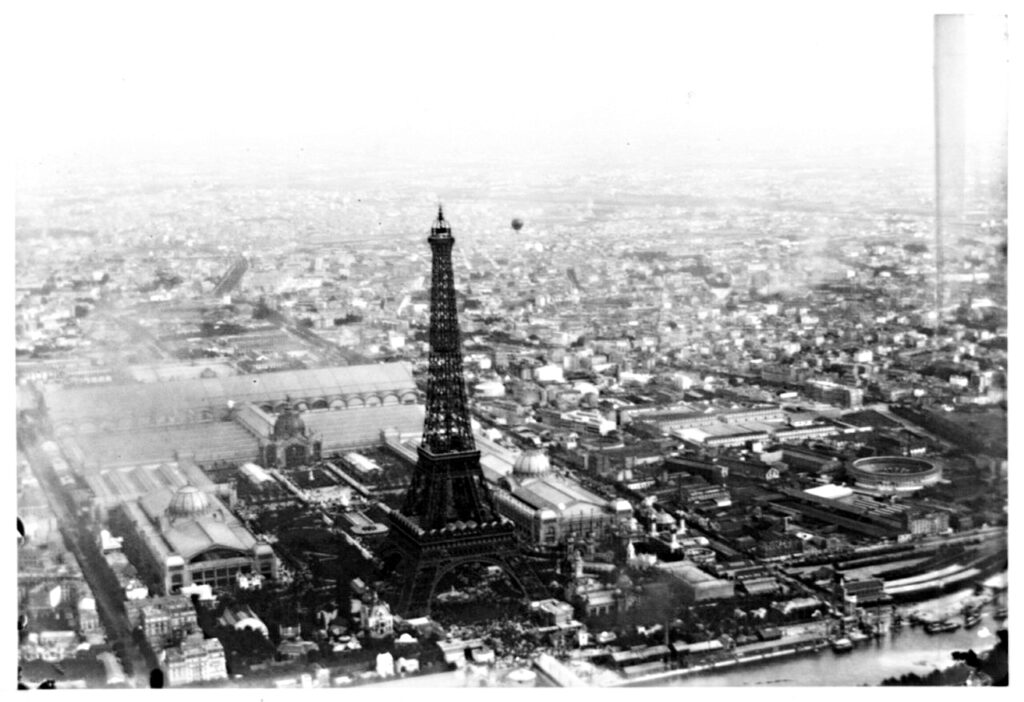
In 1887, Gustave Eiffel signed a concession with the City of Paris: the tower he was about to build would stand for twenty years. After 1909, the land would be returned and the structure dismantled.
The 1889 Exposition Universelle was a celebration of the centenary of the French Revolution, and France had chosen to mark it with the most ambitious engineering project ever attempted in the centre of a capital city. The tower Eiffel raised reached 300 metres – taller than any building, bridge, or monument then standing, surpassing the Washington Monument, which had held the title since 1884. It was assembled entirely from prefabricated iron sections in just over two years, with the engineering precision required by the height: every rivet hole was drilled to tolerance at the factory before delivery, and the sections arrived on site ready to fit. When completed, the structure weighed approximately 7,300 tonnes, yet the pressure it exerted on its four supports was comparable to that of a person sitting in a chair.
The exposition itself drew thirty-two million visitors. But the tower had faced organised opposition before a single rivet was driven. Architects, artists, and writers filed protests, calling it an iron blot incompatible with the city’s stone and classical proportions. A group of artists and writers published a protest letter in the newspaper Le Temps, signing as the “Committee of Three Hundred” – one member for each metre of the tower’s intended height. Among the signatories were the composer Charles Gounod, the writer Guy de Maupassant, and Charles Garnier – the architect who had designed the Paris Opéra.
Eiffel’s defence was consistent throughout: the tower was not merely a spectacle. It was a scientific instrument. Meteorological observations from 300 metres would yield data unavailable at ground level. Aerodynamic experiments could be conducted from the platform. The pressure and temperature gradients of the atmosphere at height could be measured with precision. Wind loading on tall structures – a question of obvious practical interest to any engineer building at scale – could be studied directly. The tower would earn its place through research, and the critics who called it useless would be demonstrated wrong. The concession gave him twenty years to make that argument real.
When the fair closed, Eiffel moved quickly. He established a meteorological station on the summit and began publishing observational data. He invited physicists and military engineers to use the platform. He conducted aerodynamic experiments from the tower himself. He was not naive about the stakes. Without demonstrated utility, the tower would come down in 1909 exactly as the concession specified, and the meteorological argument alone – however scientifically legitimate – was unlikely to be persuasive enough to override a land use decision by the city.
What no one had specifically planned for was wireless telegraphy.
Heinrich Hertz had demonstrated electromagnetic wave propagation in 1887 – the same year the tower’s concession was signed – but the practical implications were still being worked out when the tower opened. In November 1898, an engineer named Eugène Ducretet established the first wireless radio contact in France between the tower and the Panthéon, four kilometres away, transmitting in Morse code. The implications were immediately clear to the French military. A permanent transmitting station was established at the tower. By 1903 the station was relaying operational signals – and the strategic value of a transmitter at that height, in the centre of the country, covering distances that no ground-based installation could match, was understood in terms that the meteorological argument could not compete with. Military communications infrastructure had a constituency that scientific research did not.
By 1909, when the concession expired and the demolition question formally returned to the city’s agenda, the army’s position was unambiguous. The tower was not coming down.
Eiffel had been right in principle: the tower would find scientific and technical use. He had been wrong about which use. The meteorological and aerodynamic arguments he made so consistently contributed to keeping the structure operational during the years when wireless telegraphy was still developing. But what finally made demolition unthinkable was a technology that had not existed as a practical application when he built it. Marconi’s first successful wireless experiments came in 1895, six years after the tower opened. The survival of the most visited structure in the world depended on an invention that arrived after the fact.
Eiffel was right that the tower would be useful. The technology that made it indispensable arrived six years after he built it.
The most visited structure in the world is an antenna. People come for the view and for the ironwork. The tower has been relaying signals since 1898.