The One-Mile Future
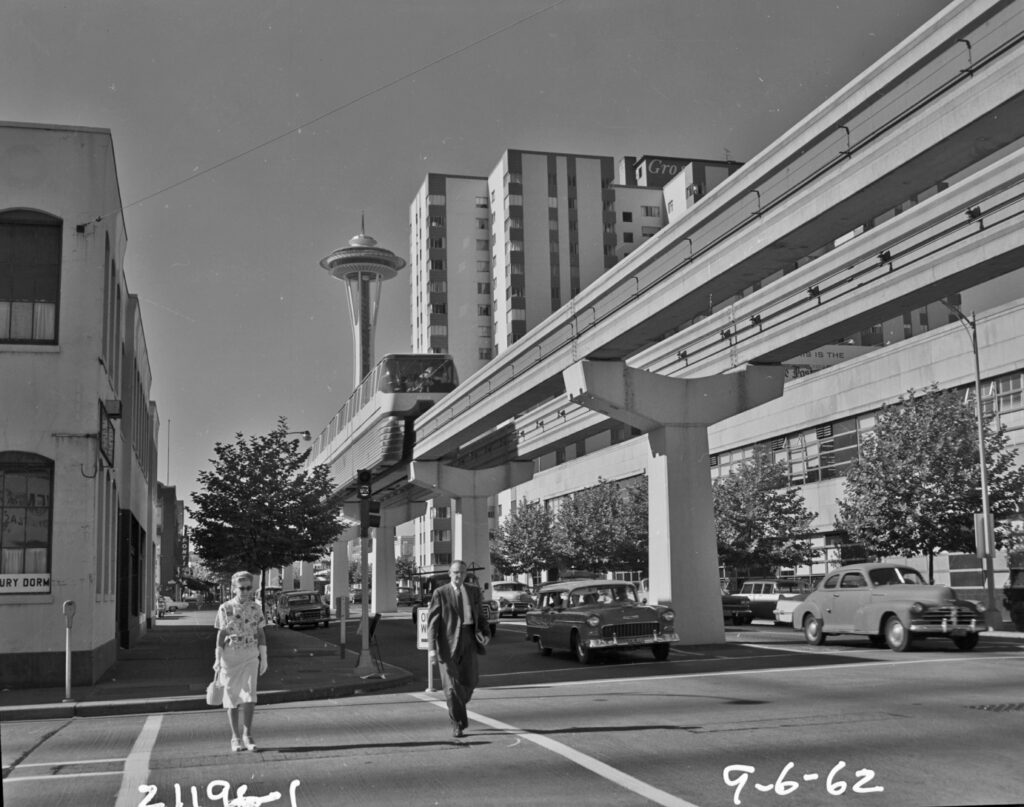
On 24 March 1962, a blue train left downtown Seattle and arrived at the gates of the future a few minutes later.
The Century 21 Exposition would not open for another four weeks. The monorail was ready early. Two trains, built in West Germany and painted red and blue, ran on rubber tyres wrapped around parallel concrete beams. Sixty-eight Y-shaped columns carried the guideway above Fifth Avenue. There were no crossings, no traffic lights, and no other trains to wait for. The route from Westlake Mall to the fairground was a little over a mile long. It looked less like public transport than an object that had escaped from the fair before the gates opened.
ALWEG, the company that designed it, had financed the construction itself. The arrangement gave the company fare revenue and a surcharge on fair admissions until an agreed threshold had been recovered. It was an unusually confident way to sell a transport system: build the demonstration at full scale, operate it in public, and let several million passengers prove the case.
They did. More than eight million people rode the monorail during the fair’s six-month run. The initial capital cost was recovered and ALWEG made a profit. The trains were fast, quiet, reliable, and visibly unlike the transport systems they were supposed to replace. As a demonstration, the Seattle monorail did everything asked of it.
ALWEG intended Seattle to serve as a working showroom for larger urban contracts. The passenger numbers seemed to supply evidence stronger than any engineering presentation could. But the evidence contained the economics of the fair itself. Riders paid for a short journey attached to an event they had already chosen to attend. Part of ALWEG’s return came through a surcharge on admissions. A six-month exposition could concentrate enough novelty and demand to repay a one-mile showcase. A transport network had to remain useful after both had dispersed.
That was the problem.
The fair made a line look like a system. Between downtown and a single destination drawing millions of visitors, almost any reliable high-capacity shuttle would have performed well. Demand was concentrated, directional, and guaranteed by the event. The trains did not need to join an existing network, serve dispersed neighbourhoods, negotiate competing rights-of-way, or persuade passengers to transfer between incompatible services. The conditions that make urban transport difficult had been removed before the demonstration began.
When the exposition closed, the conditions disappeared. The monorail did not. Century 21 Corporation retained it, and in 1965 sold it to the City of Seattle for $600,000. The trains continued running between downtown and what became Seattle Center. Proposals to extend the line appeared regularly, but the guideway remained almost exactly the length ALWEG had built for the fair.
Its political life was much longer than its route.
In 1997, a taxi driver named Dick Falkenbury and a small group of volunteers placed a citywide monorail initiative on the ballot. Their proposal imagined a forty-mile elevated system crossing Seattle in the shape of an X. It passed with 53 percent of the vote. A second initiative in 2000 authorised $6 million for planning. In 2002, voters approved a $1.75 billion first phase running fourteen miles from Ballard to West Seattle. The margin was 877 votes.
When opponents later asked voters to terminate the project, the public voted to continue. By then, the monorail had won four times.
What it had not acquired was a workable financial structure. The vehicle tax intended to fund construction produced less revenue than forecast. Costs rose. The fourteen-mile line accumulated a projected financing bill reported at roughly $11 billion over the life of the debt. In November 2005, on the fifth vote, Seattle ended the project. Around $125 million had been spent on planning and administration. No new guideway had been built.
The attraction of the monorail was not irrational. Elevated trains avoided street traffic. The original vehicles had operated for decades. The technology worked, and works elsewhere at urban scale.
But the larger forecast failed. Monorail did not become the ordinary form of urban rapid transit that ALWEG was selling. Europe built extensive metro, tram, and light-rail systems, but almost no citywide monorail networks. The technology survived. The category did not win.
Seattle’s surviving line offered something more persuasive than a technical case. It made an entire transport future visible in a single glance. One beam, one train, no congestion underneath. Light rail requires maps, timetables, junctions, substations, maintenance depots, and years of construction before the system becomes legible. A monorail arrives already looking like the future.
That legibility helped it win attention, affection, and repeated elections. It could not secure land, integrate networks, stabilise tax revenue, or make long-term debt inexpensive. Those tasks are less visible than the train. They are also the system.
The original monorail now carries more than two million passengers a year, many of them travelling to concerts, museums, and hockey games at Seattle Center. It is useful, popular, and still operating with the trains built in 1961. The demonstration never failed.
The red and blue trains still complete the journey in about two minutes. Sixty-four years later, the future runs between the same two destinations.
*Edition 7 of Tomorrow Was Here. Previous editions are in the series.*