The Night They Lit the World
The procurement that wired the world
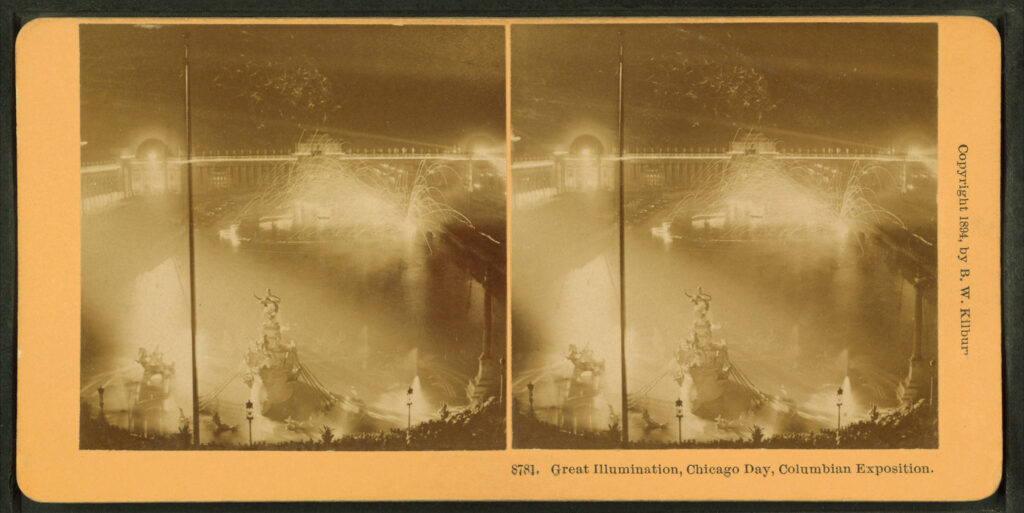
On the evening of 1 May 1893, President Grover Cleveland pushed a gilded button in Chicago and more than a hundred thousand incandescent lights came on at once.
The effect was disorienting. The scale was not architectural but meteorological. The White City – a complex of neoclassical exhibition halls designed by Daniel Burnham on the shore of Lake Michigan – had been months in the making, but nothing prepared visitors for its appearance after dark. The buildings, clad in white staff and reflecting the lake, formed what visitors described as a city from another world. Photographers could not capture it adequately. Reporters used the word “fairyland” and gave up trying to be more specific. Of the twenty-seven million people who came to the exposition over its six-month run, many returned specifically to see the grounds at night.
What they were watching was the outcome of a procurement decision.
Six months before the fair opened, two competing electrical systems had bid for the contract to power it. Edison’s General Electric proposed direct current (DC) at $1.72 million. Westinghouse, whose system ran on alternating current (AC) developed by Nikola Tesla, came in at $510,000 – then underbid further through subsequent rounds. The final margin was seventy cents per lamp. The decision was made by the fair’s construction committee on cost grounds, in a room that drew no public attention.
The technical argument between AC and DC had been running for years. Edison had argued, with some political success, that AC was inherently dangerous – it had powered the first electric chair in 1890, and he had been careful to link that fact to Westinghouse’s name in public. His campaign was thorough: he arranged public demonstrations of animals being electrocuted with AC, lobbied state legislatures, and coined the term “Westinghoused” to describe execution by electricity. The goal was to make AC synonymous with death before it became synonymous with light.
The engineering reality was less dramatic. AC could be stepped up to high voltage for efficient long-distance transmission and stepped back down for use at the point of delivery – something DC could not do at comparable cost. A DC system required a generating station within roughly a mile of its customers. An AC system could power a city from a plant many miles away. For anyone building infrastructure at national scale, the arithmetic was clear. By the late 1880s, engineers who had examined the numbers already knew which system would prevail. What remained was the public argument.
The 1893 exposition settled it – not by demonstrating AC’s technical superiority, but by demonstrating its normality. Twenty-seven million visitors rode elevators powered by AC motors, watched AC lighting run without incident for six months, and left convinced that this was simply what electricity was. Nikola Tesla gave demonstrations at the fair himself, lighting fluorescent tubes wirelessly and running AC motors before crowds in the Westinghouse exhibit. The apparatus was spectacular. But the decision had already been made, months earlier, in the procurement process.
Edison lost the public argument because the fair made the abstract technical case concrete and experiential. Westinghouse had not won the War of Currents in a laboratory. They had won it by being cheaper, by being chosen, and by running their system in front of the largest captive audience in American history.
Alternating current became the standard for every electrical grid built subsequently. The infrastructure of the modern world – the grid, the transformer, the domestic socket – runs on a decision made in a bid document in 1892. The fair did not make that decision. It made the decision feel inevitable.
In 1893, the future meant electric light, everywhere, all night. In 2026, the question of which electrical system the future runs on has returned – with different names and different contenders, but recognisably the same structure: competing visions, a procurement decision, and a spectacle designed to make the outcome look like it was always going to happen.