The Walkway That Waited
Built for a fair: Saved by a radio mast
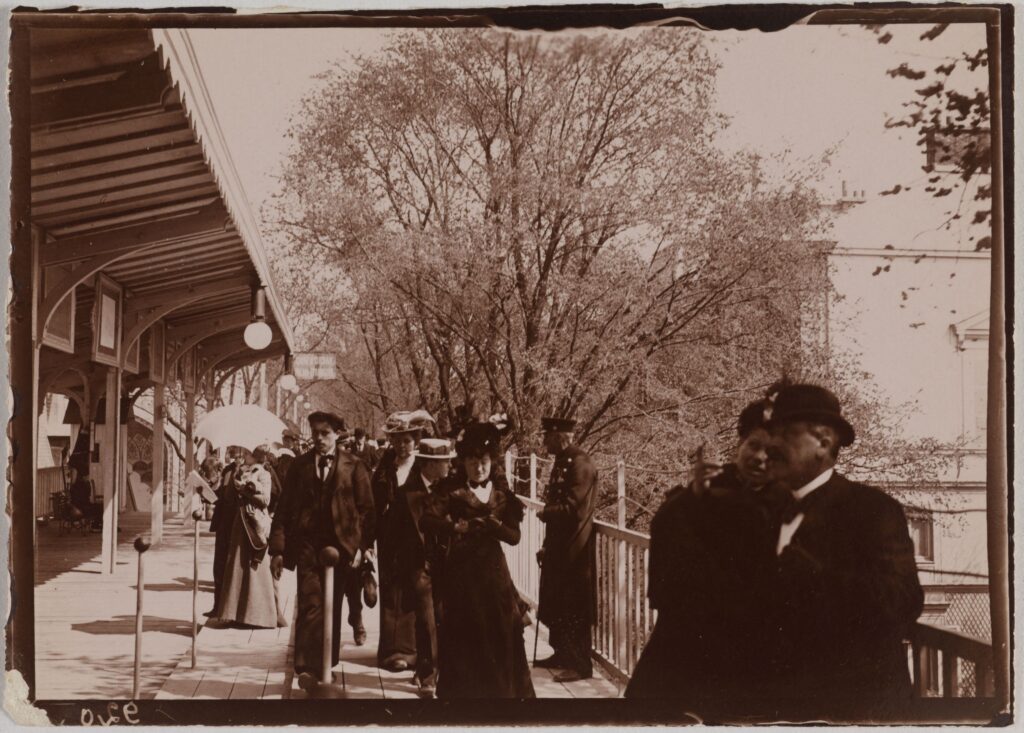
At the 1900 Exposition Universelle in Paris, millions of visitors stepped onto a platform that moved.
The trottoir roulant – the rolling pavement – was not a fairground attraction in the usual sense. It was a functioning transit system, running for several kilometres along the Quai d’Orsay and around the exhibition grounds. It operated on three parallel tracks at different speeds: a stationary platform, a slow belt at roughly four kilometres per hour, and a faster belt at roughly eight. You stepped from the ground onto the stationary platform, crossed to the slow belt, then transferred to the faster one. It required no driver, no ticket, no timetable, and no transfer point. It simply carried you from one end of the fair to the other, continuously, with no interruption.
The engineering was genuinely novel. The platforms were supported on a continuous framework of iron girders and ran on electric motors – the same AC technology that the earlier Chicago fair had used to illuminate its grounds now being applied to movement. Thirty million visitors came to the 1900 exposition, and a substantial share of them rode the trottoir roulant. Journalists described it as the logical next step for the modern city. Several proposals followed almost immediately for permanent installations in Paris, London, and New York.
None of them were built.
The trottoir roulant was dismantled when the fair closed. The proposals came to nothing. For the next half-century, no city built anything like it.
The proposals were not forgotten. In July 1921, the City of Paris organised a formal competition for “a continuously moving mechanical system for quickly conveying people through the main streets of Paris.” Thirty-eight proposals arrived from engineers across Europe. The main concept under consideration was a network of subterranean moving walkways beneath the city’s streets – an underground extension of the same idea the fair had demonstrated above ground. Fulgence Bienvenue, the engineer who had designed the Paris Métro, was involved in overseeing the submissions. Twenty-five proposals were eliminated outright. The thirteen that survived examination were ultimately not built. The competition closed without producing a deployed system.
Not because the engineers lacked imagination. Because the city still did not match what the infrastructure required.
The trottoir roulant required a specific set of conditions to be useful: long, straight corridors of enclosed space; a population with no practical alternative to walking; distances long enough to justify the infrastructure cost; and a concentration of foot traffic dense enough and directional enough to fill the belts. The 1900 fairground had all four of these conditions simultaneously, which was precisely why it worked so well there. The city outside the fairground gates had none of them in combination. Paris in 1900 had long boulevards, but they were not enclosed, not captive, and not consistently directional. No existing urban environment matched the profile the walkway required.
The hidden assumption behind the proposals was that pedestrian behaviour would adapt to the infrastructure. In the fairground, it had. But the fairground was a controlled environment where visitors had nowhere else to go and nothing to distract them from the novelty of the technology. The city was neither controlled nor captive. The people in it had choices. And when people have choices, the conditions for infrastructure adoption become much more demanding.
What the designers had not considered was the reverse relationship: infrastructure does not create the conditions for its own adoption. It takes hold when the conditions already exist – when the behaviour it requires is already present and being satisfied only inadequately.
That set of conditions was eventually invented, though not for Paris, not for city streets, and not for any reason connected to the trottoir roulant.
Dallas Love Field installed the first airport moving walkway in 1958. By 1960, American Airlines at Los Angeles International was branding theirs the Astroways and launching them with celebrity fanfare. The airport terminal was the environment the trottoir roulant had been waiting for without knowing it: sealed, climate-controlled, with long straight corridors, a captive population that had no alternative to walking, distances between gates that were consistently too long for comfortable walking under time pressure with luggage, and traffic dense and directional enough to justify continuous mechanical belts. Every single condition the city had failed to provide, the airport terminal provided by design.
The walkway spread to every major hub on earth. It is now so unremarkable that most passengers ignore it while looking at their phones – which is exactly how successful infrastructure should feel.
The trottoir roulant was not ahead of its time in the sense that people were not ready for it. The people at the 1900 exposition were ready – they stepped onto it without hesitation and rode it enthusiastically. It was ahead of its context: the specific building type that made it necessary did not yet exist, and would not exist for six decades.
In 1900, the future meant movement without effort. In 2026, it still does – in every terminal between here and anywhere.