The Call Nobody Needed to Make
AT&T and the Picturephone
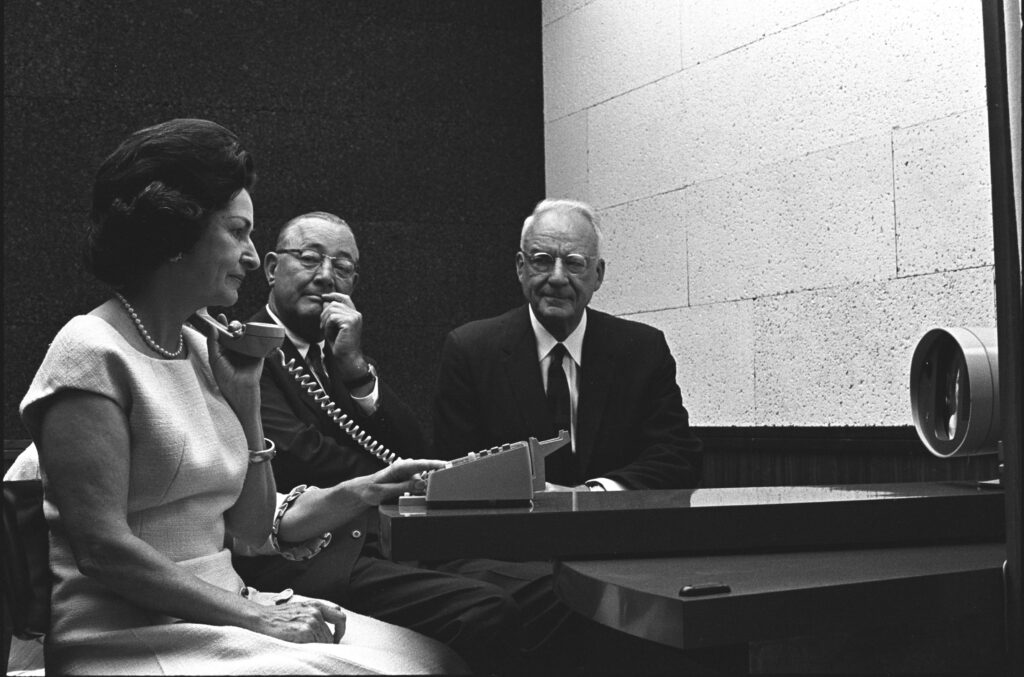
At the 1964 New York World’s Fair, visitors to the Bell System pavilion queued to see the future of the telephone.
The exhibit had eight Picturephone booths – each with a small rectangular screen above a standard handset, displaying a grainy black-and-white image of the person on the other end. The device was the product of years of Bell Labs research going back to the early 1950s. Bell researchers had been working on the problem of video telephony since before the Second World War, and the engineering challenge was genuinely substantial: capturing a moving image, compressing it to fit inside a telephone circuit’s bandwidth, and rendering it at the other end in real time were problems that required advances in electronics that did not exist at the outset. By 1964, they had something that worked – imperfectly, but demonstrably. The fair was its most prominent public showing to date.
Most visitors were connected to people in adjacent booths, though on occasion a call was placed to a matching installation at Disneyland in California. The lines were long. AT&T took this as a signal.
Bell Labs surveyed seven hundred people afterward. Half said that seeing the other person was important in a telephone call. The other half said it was not.
AT&T proceeded on the strength of the fifty percent.
By June of the same year, dedicated Picturephone rooms had opened in New York, Chicago, and Washington. A three-minute call between New York and Washington cost sixteen dollars – roughly a hundred and twenty dollars in today’s terms. Customers scheduled their call in advance, travelled to a dedicated facility, and appeared on a small screen under conditions they could not control. The image quality was poor. The frame rate made natural movement look stiff and unnatural. The conversation required sitting still, facing the camera directly, at a fixed distance from the screen. There was no way to adjust what the other person saw of you. You could not stand up and pace, turn away to consult a document, or allow your attention to drift. The call required a kind of sustained, self-conscious presence that a voice call did not. The service was withdrawn within a few years.
A commercial relaunch in 1970 offered desktop Picturephone units for office installation – smaller, somewhat improved, and aimed at business customers who might accept the fixed costs of dedicated units as a line item. AT&T had forecast a subscriber base of hundreds of thousands within five years of launch. By 1974, the service had fewer than a thousand subscribers and was effectively withdrawn for the second time.
The assumption behind the Picturephone was that people wanted to see each other when they spoke on the telephone. This turned out to be correct. The assumption behind the launch was that this desire would translate into adoption – that wanting something was sufficient for building a market around it. That assumption was wrong.
Seeing someone requires being seen. Being seen, in 1964 and again in 1970, meant scheduling in advance, paying by the minute or by the month, travelling to dedicated hardware, and presenting yourself on terms you could not set. The question was not merely technical. It was a question about when people are willing to be visible and on what conditions. A telephone call, in 1964, had a particular social contract: your voice was present but your appearance was not. That asymmetry was not a failure of the telephone. For many people and many conversations, it was the feature. The Picturephone changed the terms of that contract without asking whether the change was wanted.
Video calling did not wait until 2020 to become available. Skype introduced consumer video calling in 2006; the iPhone, FaceTime, Google Hangouts, and a succession of alternatives followed. For over a decade the technology was affordable, accessible, and increasingly convenient. Adoption remained partial. For most professional contexts, a voice call or an email remained the default. Video was reserved for the conversations worth the additional effort – the ones where presence mattered enough to justify the setup, the self-consciousness, and the mutual commitment of being seen.
In March 2020, the conditions changed. Offices closed, travel stopped, and alternatives disappeared. Within weeks, video calling was the default medium for professional life across much of the world – not because desire had grown, but because every alternative had been removed. The technology was identical to what had existed for years. What had changed was the social context surrounding it: the scheduled, self-conscious, optional quality of video calling collapsed into something simply necessary. When a voice call was no longer a social option and email no longer adequate for sustained collaboration, the remaining resistance dissolved. Not because the technology had improved. Because the alternative had gone.
The technology AT&T demonstrated at Flushing Meadows in 1964 was not wrong. Neither was Skype in 2006. The model that equated desire with adoption was wrong. A technology can be wanted, widely available, and affordable for years – and still wait for the specific conditions that make it default. In this case, those conditions turned out to be the absence of any alternative.