The Borrowed Future
The automobile city travelled by prestige
Last week: GM Futurama, 1939. The automobile city staged as inevitability. Six years later, Europe was rebuilding.
The Futurama exhibit closed in October 1939. Six years later, the cities of Europe were rebuilding – some from choice, others from rubble.
Rotterdam had been almost completely destroyed by German bombing in May 1940. The city centre was gone. When planners arrived with blueprints, they arrived at cleared land. The automobile city did not need to displace anyone. The war had already done that. Coventry was rebuilt on a similar logic. In many of the bombed cities of Germany and France, the car became the organising principle of reconstruction, arriving alongside American funding and American consultants.
What crossed the Atlantic with the money was an assumption – that the automobile city was simply what a modern city was. Not an American preference. A developmental stage that every serious country would eventually reach.
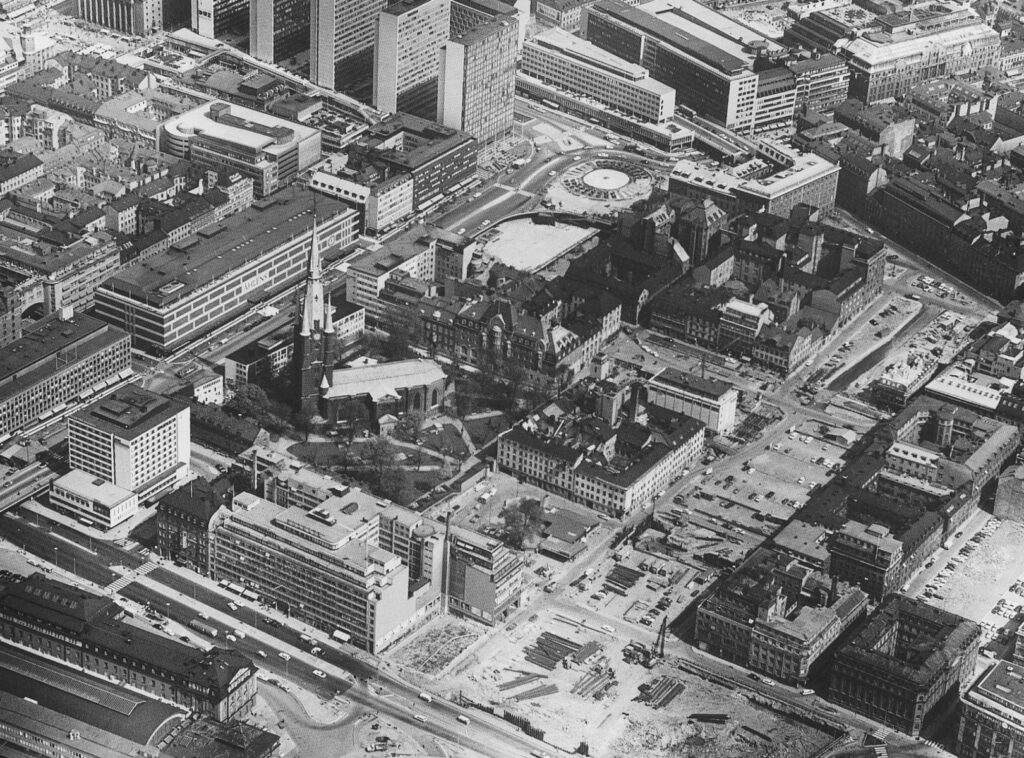
Not every European city had been bombed. Stockholm had not. But demolition of large parts of its historic Klara district began anyway, in 1952 – cleared for offices, wide roads, and an underground interchange. To its proponents, Klara represented overcrowded tenements, ageing infrastructure, and a city centre that postwar ambitions had already outgrown. The project was called sanering – literally, to make healthy. The word implied that what stood before had been diseased.
Brussels followed across the 1960s and 1970s. Whole working-class districts came down for highway corridors. The practice became so systematic that critics eventually named it after the city that did it most visibly: Brusselization. Paris built an expressway along the Seine.
What makes this a foresight problem rather than a planning history is the mechanism of transmission. Highways did not require treaties to cross the Atlantic. They traveled by prestige. European planners saw what postwar American prosperity looked like – the cars, the suburbs, the gleaming interchanges – and drew the reasonable conclusion. They wanted the same future. By the time anyone asked whether it was the right future, the concrete had already been poured.
Stockholm has spent decades reducing car traffic in the centre it demolished. Paris removed the Seine expressway. Brussels pedestrianised its core. What is being undone now was built across a generation, on an assumption that arrived from a 1939 trade fair.
This is edition 2 of Tomorrow Was Here. Edition 1 – on the 1939 exhibit that manufactured political will for the American highway system is here.