The Future They Chose to Build
GM Futurama and the automobile society
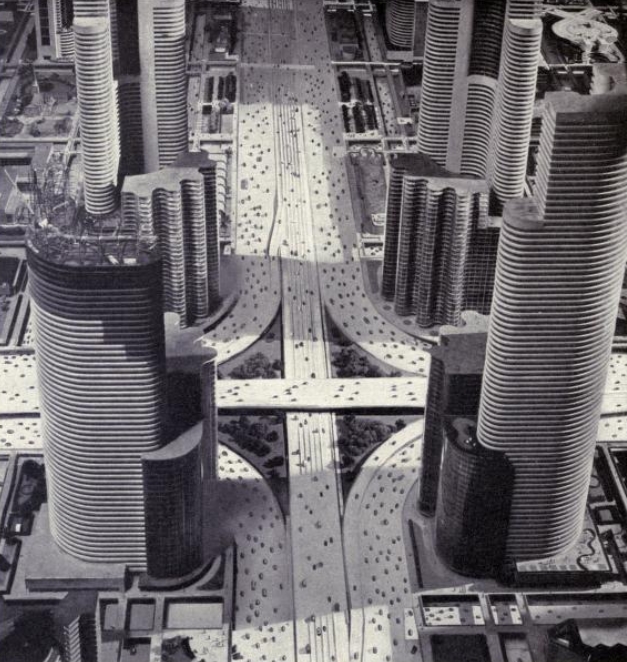
In 1939, five million people sat in moving chairs and watched the future scroll past them.
General Motors had commissioned Norman Bel Geddes to build Futurama – a vast scale model of America as it might look in 1960. Fourteen-lane highways sweeping through the countryside. Suburbs connected by interchanges. Cities restructured around the car. At the end of the ride, each visitor was handed a small pin: I have seen the future.
It was the most visited exhibit at the New York World’s Fair. It was also, in retrospect, less a prediction than a proposal.
The Interstate Highway System broke ground in 1956 – seventeen years after the fair, and almost exactly on the timeline Bel Geddes had imagined. Robert Moses was already reshaping New York along similar lines. The American city was rebuilt around the automobile with a thoroughness that would have satisfied GM’s exhibit designers entirely. Futurama did not merely anticipate the future. It helped manufacture political will for it.
This is the uncomfortable thing about successful foresight visions: they are never just exploration. They are arguments. Futurama was a beautifully designed argument for a particular set of infrastructure choices, embedded in the emotional language of wonder and inevitability. By the time the highway engineers arrived, the future already felt like it had been decided.
What Futurama did not show: who paid for the highways, who was displaced to build them, what happened to the cities whose centres were removed to make room, or what kind of energy system would be needed to run it all. Those were the hidden assumptions – not predictions, but political choices dressed as inevitability.
Considerable effort is now being spent trying to undo what was built. Congestion charges. Fifteen-minute cities. EV transitions. Urban highway removals. The 2020s are, in many places, an extended argument with a 1939 exhibit.
In 1939, the future meant frictionless movement. In 2026, the future increasingly means reducing movement altogether.